ONE DEEP CAPABILITY IS ENOUGH
BE DEEPLY GOOD AT ONE HARD THING.
Sources, optics, tracking, software, receivers, power electronics, thermal engineering, test, electromagnetic acceleration, orbital mechanics, or lunar manufacturing. We are combining people who can own real hardware—not searching for one finished generalist.
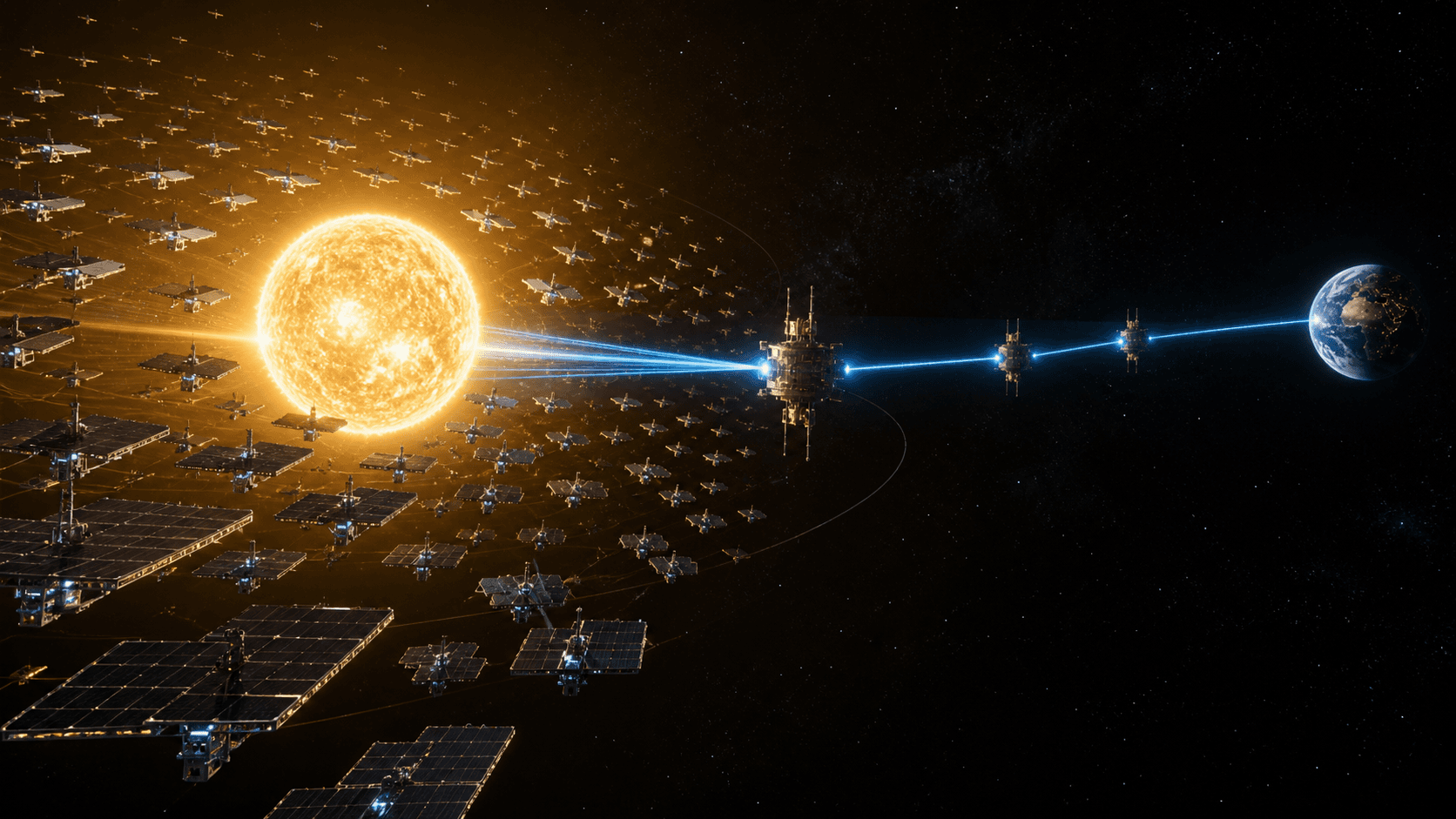
CORE OF THE LASER POWER NETWORK
THREE BOUNDARIES
WE CANNOT DELETE.
Transmission, optical relay and routing, and reception are the first three ownership boundaries. If one person cannot cross adjacent boundaries in hardware, we divide the role; we do not delete the technology the system requires.
01High-power CW laser source and transmitter
HIGH-POWER CW LASER SOURCE & TRANSMITTER
Own the design, integration, and demonstration of a transmitter that converts facility power into a high-quality CW laser that can be captured at long range.
THE EVIDENCE WE VALUE
- You personally designed, assembled, and tested a CW laser, amplifier, source module, or high-power semiconductor source.
- You calibrated electrical input, optical output, spectrum, M²/BPP, and temperature, and can explain the first failure mode as output increased.
- You designed and tested a source array, beam-combining system, high-power optical package, or thermal architecture in hardware.
THE TECHNICAL BOUNDARY
- Compare PCSEL, direct-diode, fiber, and other candidates by total source-system loss and scaling behavior.
- Measure optical output, device WPE, source-system efficiency including drivers and thermal control, and M²/BPP simultaneously at the same CW operating point.
- Distinguish single-source scaling, independent-beam addition at the receiver, spectral combining, and coherent combining; design for thermal behavior, sidelobes, and fault isolation.
- Integrate power supplies, packaging, cooling, and transmit optics; measure steady-state thermal conditions during continuous-wave operation and long-duration drift.
02Optical relay, PAT, and dynamic N×N network
OPTICAL RELAY, PAT & DYNAMIC N×N NETWORK
Own the design, integration, and demonstration of the N×N network that safely connects many moving power sources and destinations through optical-through relays.
THE EVIDENCE WE VALUE
- You built hardware for space optical communications, free-space optics, beam directors, adaptive optics, or laser communication terminals.
- You closed an acquisition, tracking, and pointing loop on a moving target and measured residual error and capture fraction.
- You implemented multi-satellite autonomy, path optimization, handover, or safety-critical flight software.
THE TECHNICAL BOUNDARY
- Integrate receive and transmit telescopes, coarse pointing, beacon acquisition, point-ahead, fast-steering mirrors, and wavefront correction.
- Measure stage efficiency through the useful power captured by the next aperture—not internal transmission alone.
- Update path and output allocation in real time as generation, demand, satellite position, weather, and faults change.
- Implement and verify make-before-break handover, fault isolation, and independent shutdown for mispointing through the flight-software boundary.
03Laser receiver and power conversion
LASER RECEIVER & POWER CONVERSION
Own the design, integration, and demonstration of a receiver that converts laser power entering the aperture into stable electricity usable by the customer.
THE EVIDENCE WE VALUE
- You designed or measured a PPC, III–V solar cell, multijunction cell, or receiver operating under high irradiance and laser illumination.
- You implemented and tested MPPT, power conversion, high-power DC buses, or protection under changing input.
- You crossed optical, electrical, and thermal boundaries and demonstrated continuous performance through to load output—not just an isolated cell.
THE TECHNICAL BOUNDARY
- Co-design a wavelength-matched photovoltaic power converter (PPC), receive and homogenization optics, and the cell array.
- Build efficiency maps from laser input to electrical output across irradiance, incidence angle, temperature, spectrum, and nonuniform illumination.
- Integrate series resistance, cell topology, MPPT, DC/DC conversion, inverter, protection, and failed-cell isolation.
- Solve local heating and heat rejection; measure from laser input at the receive aperture to load-side output net of cooling and control auxiliary consumption.
HOW WE ASSESS BUILDERS
SHOW WHAT YOU BUILT.
SHOW WHAT YOU MEASURED.
We care more about what you personally designed, what you measured, what failed, and how you fixed it than about the name on your résumé. Papers, test logs, CAD, code, patents, personal projects, and student-team hardware are all welcome.
01BUILD
Show us the last system you built with your own hands and the boundary you personally owned.
02MEASURE
Explain the efficiency boundary, input and output, run time, temperature, calibration, and uncertainty.
03BREAK & SCALE
Tell us what failed most often and what would fail first if the system were scaled by 10×.