MODULAR
Repeatably manufacture standardized generation and transmission units, then add them incrementally in orbit.
TECHNOLOGY / DYSON SWARM
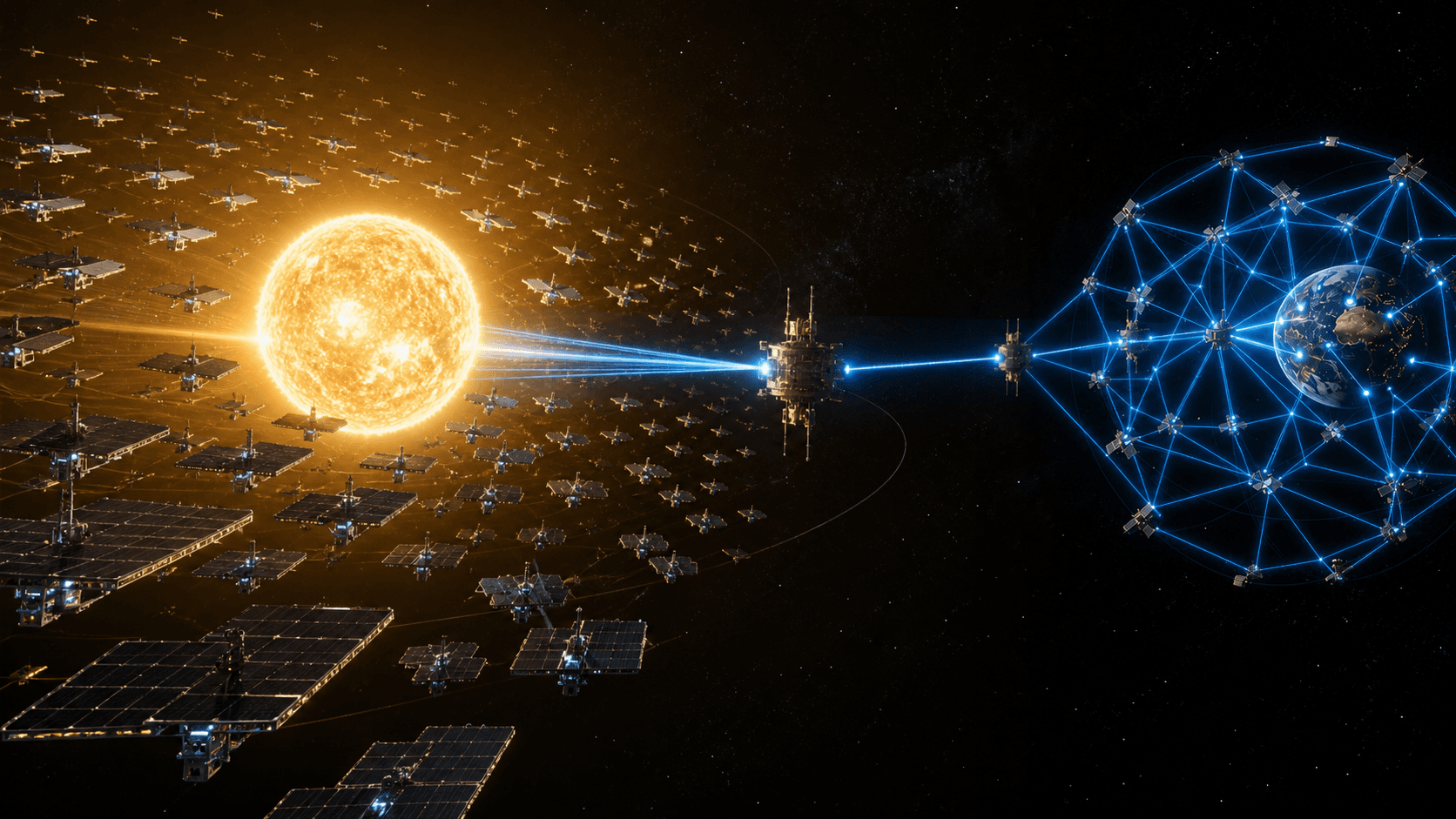
Not a single shell around the Sun, but a fleet of independent power satellites. Construction mass moves from the Moon; energy moves by laser toward Earth—a modular infrastructure that can expand one unit at a time.
THE ARCHITECTURE
Generation, attitude control, power transmission, and fault isolation are distributed across a satellite fleet. Capacity can grow before the full system is complete, and individual failures can be isolated to reduce single points of failure.
Repeatably manufacture standardized generation and transmission units, then add them incrementally in orbit.
Distribute generation and failure risk across many independent spacecraft instead of one monolithic structure.
Route power by laser from near the Sun to the low-Earth-orbit network as demand and available paths change.
WHY STELLAR ENERGY
As electrification, AI, robotics, autonomous mobility, and manufacturing expand, usable power increasingly sets the pace of civilization. Moving closer to the Sun increases the solar irradiance incident on the same collection area by orders of magnitude.
A comparison point at one tenth of the Earth–Sun distance. The operating orbit has not been selected.
By the inverse-square law, the same area receives roughly 100 times the irradiance at 0.1 AU as at 1 AU. Electrical output still depends on conversion efficiency and thermal design.
A reference ratio comparing an external working definition of 40 kW per person with 2019 global primary-energy use per person. It is not a MUSEN product target.
CGO / SOURCE ↗A distant civilization-scale reference comparing Sagan’s 10-petawatt Type I threshold with current global energy use. It is not a generation multiplier.
FERMILAB / SOURCE ↗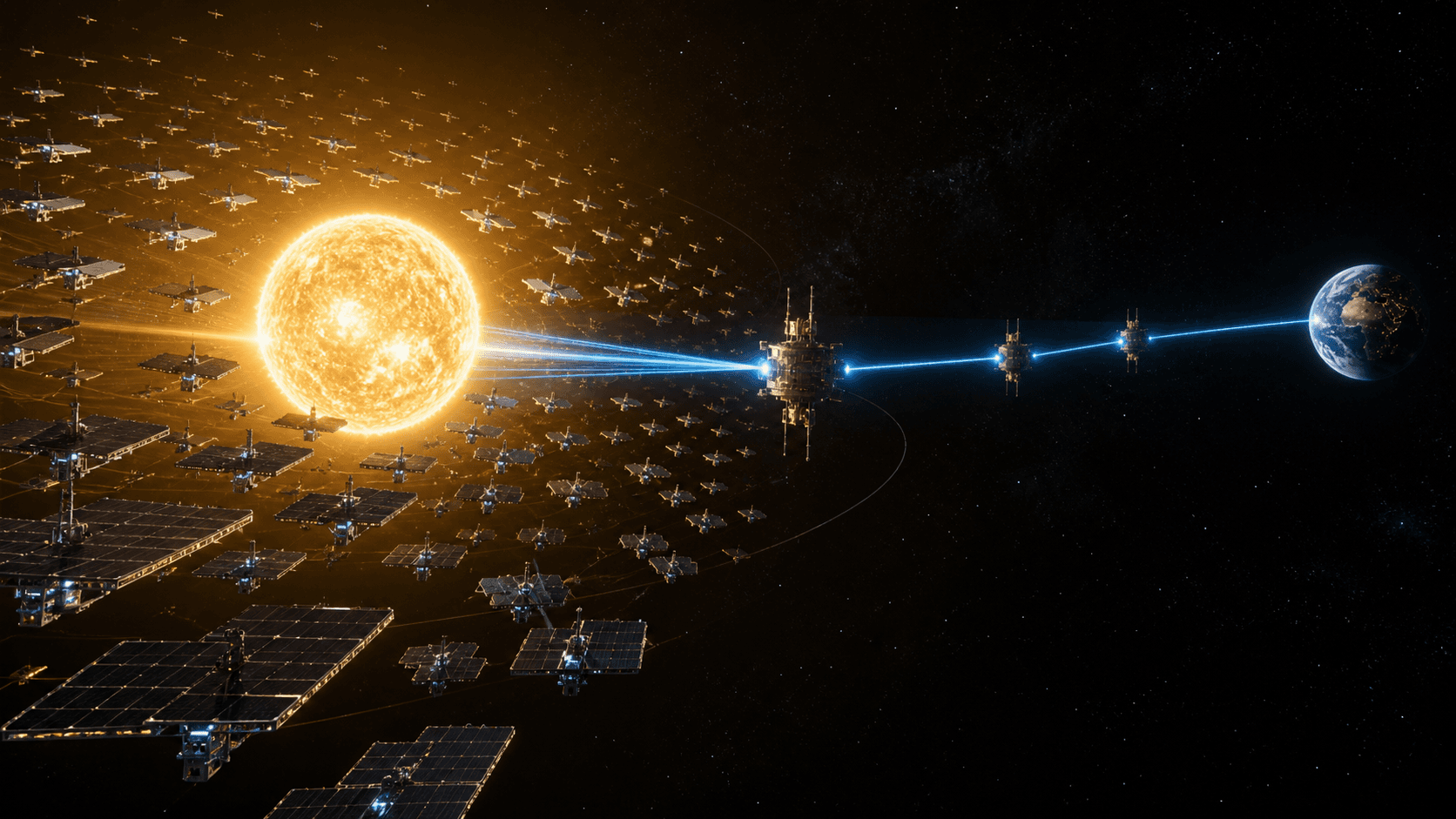 LONG-TERM CONCEPT VISUAL
THE TWO BUILD STREAMS
A Dyson swarm requires both mass transport that supplies near-Sun construction orbits with structures made on the Moon and energy transport that delivers the fleet’s power by laser through low Earth orbit to demand centers.
TRACK A / ENERGY DELIVERY
Surplus generation region → low-Earth-orbit satellite network → power-short region
Low-Earth-orbit satellite network → electric aircraft cruising above the clouds
Near-Sun power-satellite fleet → low Earth orbit → demand centers
TRACK B / CONSTRUCTION LOGISTICS
Manufacture solar panels, structural material, and related equipment from lunar regolith.
Launch cargo from the Moon repeatedly and at high cadence with a mass driver.
Capture cargo in orbit, then supply construction orbits through orbit change, added propulsion, and transfer.
One stream transports the structures that expand generation capacity. The other transports the energy produced by that capacity to where it is needed.
THE MISSION
We are decomposing this long-term objective into falsifiable problems across optics, power, space transportation, and manufacturing. Help us solve the hardest one.
REQUEST A FOUNDING INTERVIEW ↗