LOWER ESCAPE BURDEN
Accelerate in vacuum from a gravity well shallower than Earth’s.
TECHNOLOGY / LUNAR LOGISTICS
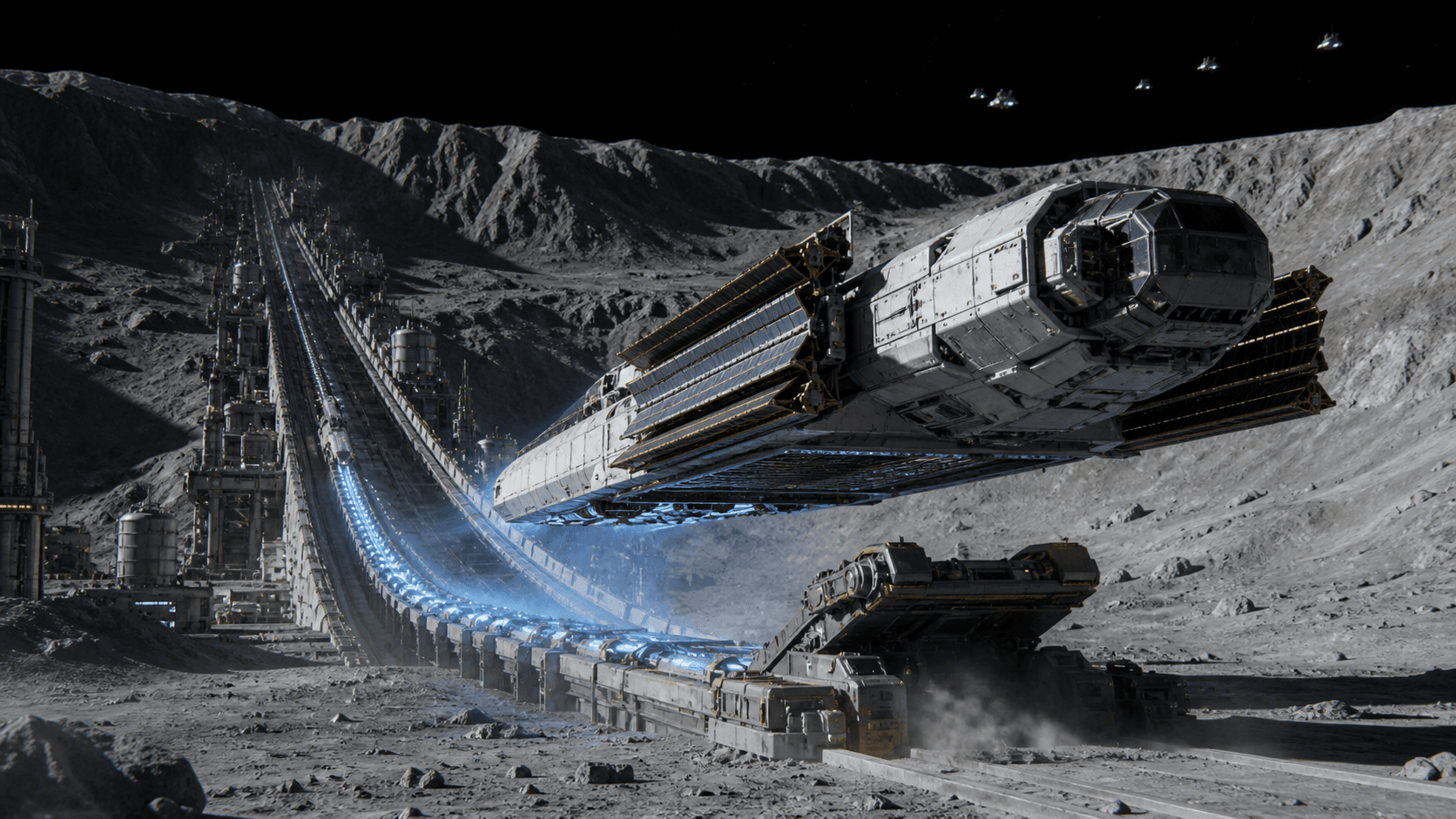
Manufacture solar panels and structural material from lunar resources, then launch them repeatedly with electromagnetic acceleration. Dyson-swarm construction cannot depend only on individual launches from Earth.
WHY THE MOON
The Moon has lower gravity than Earth and essentially no atmospheric drag. By imparting kinetic energy with an electromagnetic accelerator, we aim to build a high-throughput transport system that does not consume a launch vehicle and chemical propellant for every departure from the lunar surface.
Accelerate in vacuum from a gravity well shallower than Earth’s.
Reapply electrical power and launch cargo repeatedly from the same lunar infrastructure.
Process lunar material and reduce the mass that must be lifted from Earth.
INITIAL GROUND EXPERIMENT
Test whether a ground facility can accelerate a several-tonne article to the equivalent of lunar escape speed. Measure the acceleration track, power system, guidance or levitation, structure, thermal behavior, and release accuracy as one system to establish the conditions required for a lunar machine.
PROGRAM TARGET / NOT YET DEMONSTRATED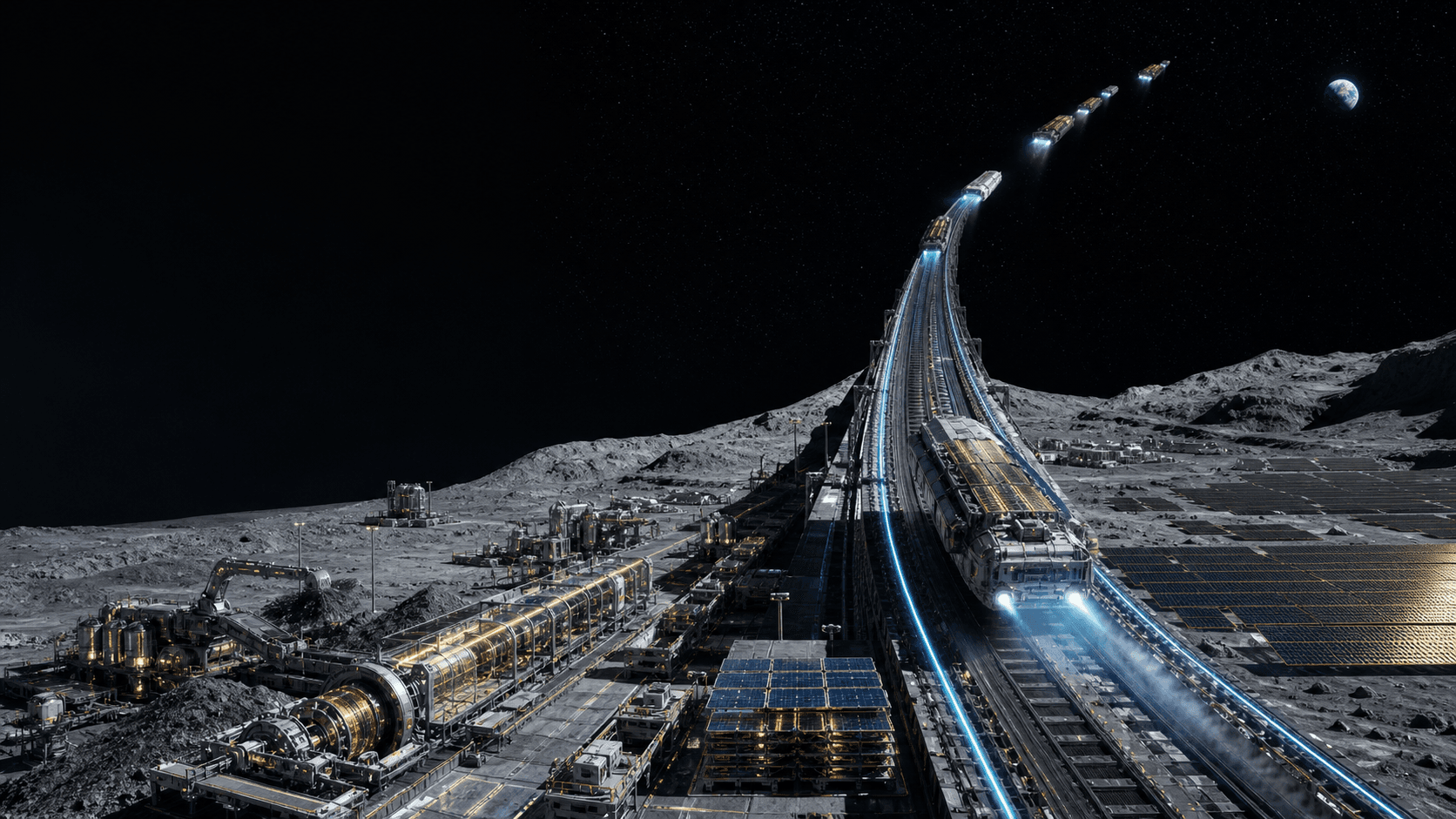 CONCEPT VISUAL
END-TO-END LOGISTICS
A mass driver supplies the initial velocity off the lunar surface. The transport system must then capture the released cargo and carry it through orbit change, added propulsion, and transfer trajectories—including gravity assists where useful—to construction orbits near the Sun.
Mine and refine lunar resources into solar cells, support structures, and transport containers.
Load cargo into the track in a form that can survive acceleration, electromagnetic loads, heat, and vibration.
Control lunar orbital phase, launch time and azimuth, and velocity error to release cargo into a capturable trajectory.
Capture cargo in orbit, then move it toward the Sun through added propulsion and transfer trajectories that may include gravity assists.
Deploy and assemble independent power satellites, then repeat the logistics cycle.
ENGINEERING FRONTIERS
The governing risks are not solved by making the track longer. We will use ground testing to challenge the dominant failure modes of the complete system, one by one.
Co-design track length, velocity, and power around the acceleration the cargo can survive.
Energy storage, switching, coils, and thermal management that deliver very high power over short intervals.
Measurement and control that constrain launch-direction and velocity error to a capturable dispersion.
Insulation, wear, dust, heat rejection, and long-duration maintenance in the lunar environment.
Detection, guidance, capture, impact mitigation, and reusable logistics containers for high-speed cargo.
JOIN THE BUILD
Railguns, linear motors, electromagnetic catapults, pulsed power, long acceleration tracks, lunar resource utilization, orbital GNC, or capture: we want to speak directly with people who can turn any one of these domains into hardware.
REQUEST A TECHNICAL INTERVIEW ↗